MAKHAN
SINGH BAINS’S CHACHA JI S. SOHAN SINGH BAINS PASSED AWAY
Our sympathy
goes out to the family of S. Makhan Singh Bains ( Raja Sweets
in California) on passing of their uncle (Chacha Ji) S. Sohan
Singh Bains resident of Village Mallan Bedian, who died on December
26, 2010. Late Sohan Singh Bains was very well known personality
in their area. For more information please contact at (510) 489
9100
Editor: Ambedkartimes.com (Posted on January 11, 2011) |
Sikh
Americans of Central Valley California Celebrated Sikh American
Awareness &
Appreciation monthwith Mainstream America
November 14, 2010 Fresno (California) |
 |
Fresno-
(Pashaura
Singh Dhillon)
:-
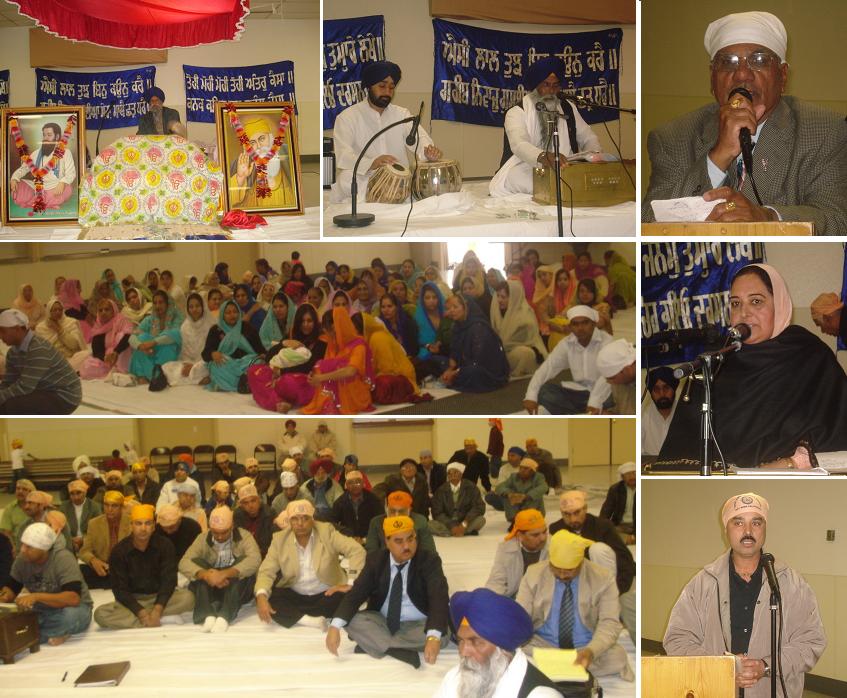
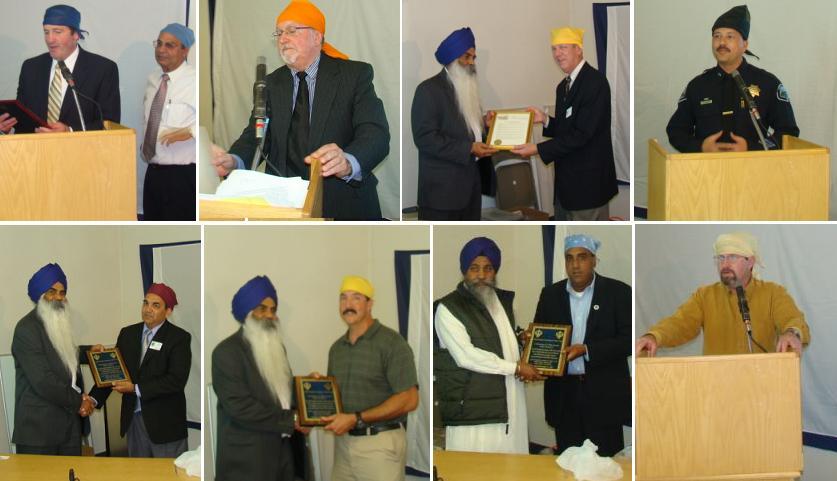
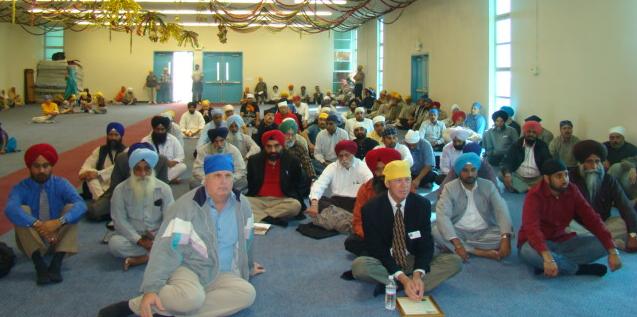
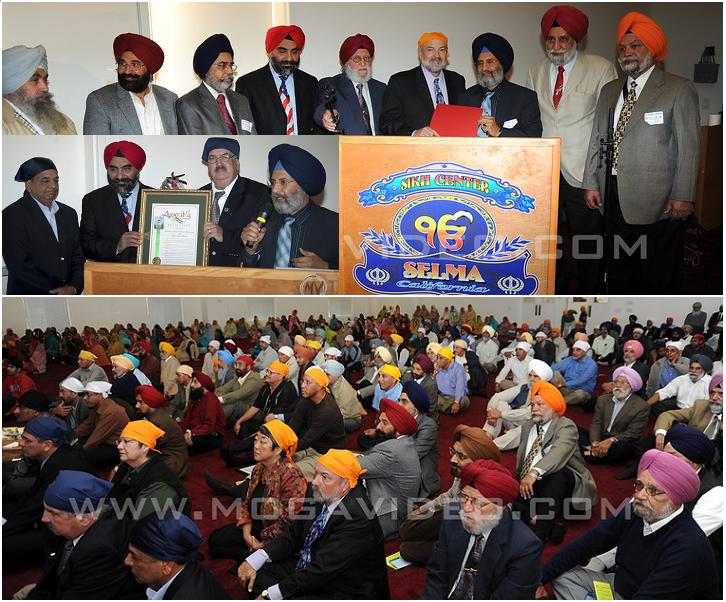
The Sikh Council of Central California celebrated its
Annual Guru Nanak Prakaash Utsav dedicated to Honoring
Assembly Concurrent Resolution 181 (Logue) -Relative to
California Sikh Awareness and appreciation Month on Sunday
November 14, 2010 at Selma Sikh Temple. Akin to a seminar,
the program was highly educational; brainstorming as educators
how to create awareness and fill the cultural gap using
this opportunity to bring long term benefits to Sikh Americans
and the American Community at large?
On this auspicious Guru Nanak Prakash Utsav, the 54st
Birthday of the founder of the Sikh Religion, there couldn’t
be a better tribute (Nazrana) for Guru Ji, than the California
Legislature has bestowed in passing its unanimous Resolution181;
a resolutionnow enthusiastically
|
being honored with adopted proclamations by the county and city
governments as well as by the school districts all over the state.
No doubt there is a long way to go but this measure is a big step
in the right direction in dispelling some of the serious misconceptions
about the Sikh Americans, caused by the 911 tragedy. However belated,
the Sikh American community greatly appreciates it and is thankful
to the legislature in its entirety especially, to Assembly Member
Daniel
Logue for passing this resolution.
This event was not a mission in advocating a particular community
or religion to the multiethnic and multicultural population as
such, but the Sikh Americans need to use all possible means of
educating fellow Americans about who they are and ensure that
their identity is not to be mistaken or abused. If this was the
case with any other community, the values of the Sikh faith demand
that a Sikh stands up and demands that no one, regardless of faith
or creed be barred from practicing their faith freely; that no
one be denied justice and compassion. All presentations were focused
to explore the ways and means especially through our educational
system that allows the Sikh Americans to work together towards
new progressive educational initiatives that benefit Sikh American
students and help close the cultural awareness gaps that currently
exist in text books between them and their peers. The possible
use of California Department of Education approved Supplemental
Instructional Material in classrooms and school districts as a
way of attaining mutually beneficial objectives was demonstrated
through videos, power point presentations and to the point speeches,
on this occasion.
The
carefully selected participants made excellent presentations and
the whole program with a packed hall went according to the plan.
Lot of young students from the Gurdwara schools along with their
teachers and parents attended and watched every video and presentation
with great interest.
The program started sharply at 11 AM after the Bhog Shri Akhand
Patth and Kirtan by the Hazoori Ragis of the Selma Temple. Dr.
Ranjit Singh Rajpal General Secretary of the SCCC shared greetings
of the Gurpurb, gave a brief introduction on the Sikh philosophy
and welcomed all participants. Pashaura Singh Dhillon, the Education
Coordinator gave a brief synopsis of the program as a Master of
the Ceremonies and briefly touched upon why the Sikh Americans
needed this Resolution 181although they have lived in California
for more than a century. Now they have got it how best to use
it to realize its full potential in creating awareness among fellow
Americans. Apart from other venues, Mr. Dhillon emphasized the
role of classrooms in public schools where it all begins. A couple
of videos ‘Meet the Sikhs ‘ and ‘Understanding
Sikhism were shown which were produced by Dr. David Hosley while
he was C.E.O at the PBS KVIE Sacramento. These videos are available
on You Tube and are approved by the California Department of Education.
Dr
David Hosley was introduced by Dr, Onkar Singh Bindra of Sacramento
who along with Dr.Jasbir Singh Kang and other community members
especially from Yuba City, worked closely with Dr. Hosley in preparing
these videos. Dr. Hosley now an Interim Vice Chancellor of UC
Merced spoke briefly and shared his experience with the congregation
and was honored by the SCCC with a Commendation Certificate. Dr.
Jasbir Singh Kang made a comprehensive power point presentation
covering 120 years of Sikh American history in California, genesis
and background of ACR 181 and Achievements of the Sikh Community
in California. He also introduced Assembly Member Daniel Logue,
author of the ACR 181. Mr. Logue glowingly appreciated the Sikh
American community and thanked for their patriotism, hard work
and valuable contribution to this Golden state.
Dr.
Onkar Singh Bindra of Sacramento made a very impressive and brief
presentation to create awareness, demonstrating some practical
ways through classroom in public schools, libraries, work places
and other venues of interaction with other communities through
his personal involvement. Robert Frausto, Kerman Unified School
District Superintendent topped it all, by offering to inculcate
all the Supplemental instructional material as approved by the
CDE in the classroom in his school district of Kerman without
delay. Mr. Frausto touched upon AC 181 Resolution passed by the
State Assembly declaring November 2010 Sikh American Awareness
and Appreciation Month and what that means to public school districts.
To every one’s delight he explained what specifically the
Kerman Unified School District was currently doing to promote
Sikh awareness and appreciation and the duty of public education
in promoting multicultural awareness and cultural sensitivity
in the public school setting. It is appropriate to state here
that the Kerman Sikh American Community because of its leaders,
is way ahead from others except perhaps Yuba City where Punjabi
course is being taught for the past some years in schools
.
Other Sikh American organizations and representatives who took
part and made powerful and focused presentations relating to ACR
181as to what has been done in the past by their respective organizations
and what are the future plans to honor the resolution and create
awareness among fellow Americans to fill the cultural gap were
as follows: Simranjit Kaur Sandhawalia and Iqbal Singh Bains from
JAKARA, Raj Singh Dadhesha from SALDEF, Manvinder Singh from United
Sikhs, Jessi Kaur and Reshma Kaur from KAUR Foundation. The program
ended with the donation of several hundred blankets to the representative
of Poverello House Fresno; A word of thanks for the program well
accomplished by the General Secretary and Ardas at 1.45PM.
The
Langar as usual was served all day long. Media coverage was provided
by most local TV channels and newspapers. Moga Video provided
free photo and videography to cover the occasion. Special thanks
go to the entire management committee of the Sikh Temple Selma
for their close cooperation with the SCCC and for playing host.
Special thanks are also in order for the special committee members
set up for this function to assist the Education Coordinator,
without their help this would not have materialized.
Posted on www.ambedkartimes.com (November
23, 2010
|
ACR 181 (Logue)
- Sikh Awarenes & Appreciation Month Honored by local TV Stations
Dear
Editor,
At
my request for honoring ACR 181(Logue), which designated November
2010 as Sikh Awareness and Appreciation Month, the PBS/KVIE Sacramento
televised their video, Sikhs in America, on Nov. 6, 7 and 21,
Further, the RCCTV is televising Sikh videos (Sikhs in America
of KVIE, Cultural Safari of www.kaurfoundation.org , and Sri Guru
Granth Sahib documentary by Kalsi) on Comcast channel 20 and Surewest
channel 19 during November as per schedule below: Wednesdays –
9am to 10am; Thursdays – 10am and at 4pm; and Fridays -
5:30pm and at 6:30pm. Those who do not have access to said cable
channels may log on towww.rcctv.net on their computer, scroll
down to the lower part of the front page and click on the "simulcast".
Readers may inform their friends, colleagues and neighbors.
Onkar Singh Bindra, Ph. D.,
(osbindra@yahoo.com)..Ph.(916)858-2650 Posted
on www.ambedkartimes.com (November 22, 2010 |
SIKH
AMERICAN AWARENESS AND APPRECIATION
MONTH IN CALIFORNIA, NOVEMBER, 2010. |
Hello Respected
Sir,
Satsriakal ji
I am feeling honoured to communicate with you through this email.
Actually i am a writing you this email to share a very urgent
and most important news with you. You may be aware that Legislature
of California has passed a resolution No.181 i.e. SIKH AMERICAN
AWARENESS AND APPRECIATION MONTH IN CALIFORNIA, NOVEMBER 2010
I am sending
you the complete info in attachments,now its my humble request
that please write few words in your esteemed paper about it.
Also do publish the Brochure that we have prepared to make Non
Sikhs aware of who THE SIKHS ARE? On behalf of SIKH COUNCIL
OF CALIFORNIA we are also conducting a big awareness function
In Selma Gurudwara Sahib on November 14,2010 where we are showing
various videos like MEET THE SIKHS,SIKHS IN AMERICA,CULTURAL
SAFARI to non sikh guests including local politicians,and delegates
from different departments.
We are
requesting all other newspapers too. Its a noble cause and we
should all work together to make it a sucess,afterall its a
matter of sikh identity
We are running a radio show too i.e.Punjab News & Views
www.punjabnewsandviews.com where we are discussing about it
every Sunday 3pm-4pm. I hope that you will definitely join us
in this noble mission and do publish the said brochure with
few words from you about SIKH AMERICAN AWARENESS AND APPRECIATION
MONTH IN CALIFORNIA, NOVEMBER, 2010.
Please do confirm me about this and also do not hesitate to
contact me for any further information if required
You can even contact
S.Pashaura Singh Dhillon,
Education Co-ordinator, SIKH COUNCIL OF CALIFORNIA Contact:
559-708-4399
Hope for your positive reply and support. Thanks and regards
Gurtej Singh Cheema
Agri.Officer, California State Department of Food & Agriculture,
Fresno,California
Posted
on www.ambedkartimes.com (November 10, 2010
|

Sikh Awareness & Appreciation Month |
California
Legislature recognized and acknowledged the significant contributions
made by Californians of Sikh heritage to the state, and adopted
Assembly Concurrent Resolution 181 (Logue) on August 26. It seeks
to afford all Californians the opportunity to better understand,
recognize, and appreciate the rich history and shared principles
of Sikh Americans, their monotheistic religion and the tenets
of their faith, and the important role that Sikh Americans play
in furthering mutual understanding and respect among all peoples;
and designated Nov. 2010 as Sikh Awareness & Appreciation
Month.
Through his letter of Oct. 28 (http://www.cde.ca.gov/ci/hs/im/suptltrlegres0910.asp),
Mr. Jack O’Connell, State Superintendent of Public Instructions,
has advised the County and District Superintendents and Charter
School Administrators to conduct appropriate exercises to honor
ACR 181. He has also invited their attention to his letter of
November 30, 2007 (http://www.cde.ca.gov/ci/hs//im/sikhameriltr11-07.asp)
regarding the use of a short educational video.
Sikh Facts
• In USA, 99.9% of men having unshorn facial hair together
with a turban on their heads, and 100% of the boys wearing mini-turbans
(Patka) are Sikhs, who are maintaining their Sikh identity.
• Sikhism is not a branch of another religion. This monotheistic
faith was founded in Punjab (India) by Guru Nanak (1469-1539).
With nearly 26 million followers, it is now the 5th largest world
religion.
• Now, Sikhs live all over the world. Of the nearly 650,000
Sikhs in the USA, some 40% live in California.
• A Sikh place of community worship, Gurdwara, means “Door
to the Guru”. Non-Sikhs are welcome to the Gurdwara and
to the lungar, the community kitchen, where free vegetarian meal
is served to all without any discrimination.
• The 1430-page Sikh scripture (Guru Granth) is in verse
and Indian classical music. It includes compositions by Sikh gurus
and many Hindu and Muslim Saints.
• Sikhs respect other religions, and believe in equality
of all humans. Sikh prayer ends with a wish for welfare of all
humans.
• The Fact is that Sikh boys are often harassed, because
of their head coverings, viz. Patka & Turban.
• Teachers can help stop the harassment by educating the
students about the Sikh culture. They will find the following
useful: (1) CDE-approved Supplemental Instructional Materials,
e.g. Cultural Safari video of www.Kaurfoundation.org; Meet the
Sikhs and Sikhs in America videos of PBS TV Station KVIE, Sacramento
(Available on www.youtube.com & from www.kvie.org), The Boy
With Long Hair of www.sikhfoundation.org (Good for being read
out to students of grades 1-3); and the USDOJ poster, Common Sikh
American Head Coverings and Sikh Americans and the Kirpan.
Flag Khanda one God Kara Kirpan Patka Turban Dr. Saund Dr. Thind
Brief History of Sikhs in California
• Sikh immigrants have resided in California for more than
a century, the first Sikh immigrants worked on railroads, in lumber
mills, and in the agricultural heartlands of Sacramento, San Joaquin,
and Imperial Valleys;
• The Sikhs established in Stockton, California, the first
Gurdwara in 1912, and started six Guru Gobind Singh Educational
Scholarships at U.C. Berkeley in the same year.
• Sikh Americans have demonstrated particular success in
the areas of agriculture, medicine, engineering, trucking, and
small, family-owned businesses;
• Dalip Singh Saund was the first Sikh American and Asian
American member of the US Congress
(1957-63); and Bhagat Singh Thind, a U.C. Berkeley student served
in the U.S. Army in 1917-18;
• Dr. Narinder Singh Kapany of Palo Alto is acknowledged
as father of fiber optics;
• Sikh Americans have served as council members and mayors
in California (e.g. David Dhillon in El Centro, Gurpal Samra in
Livingston, Amarpreet “Ruby” Dhaliwal in San Joaquin,
and Kashmir Singh Gill in Yuba City);
• Yuba City, CA, has the largest populations of Sikh and
Punjabi Americans, and the coronation day of Sikh Scripture is
celebrated there on the first Sunday of every November, with a
parade that attracts about 70,000;
• The Sikh and Punjabi American communities of California
continue to make important contributions to our state and nation.
(osbindra@yahoo.com ; 916-858-2650) Posted
on www.ambedkartimes.com (November 10, 2010
|
SSPI
Advises School Administrators to Honor Sikh Awareness
Month |
State
Superintendent of Public Instruction (SSPI), Mr. Jack
O’Connell, has vide his letter of October 28, 2010,
notified County and District Superintendents and Charter
School Administrators that the Assembly Concurrent Resolution
181 (Logue) designates November 2010 to be California
Sikh American Awareness and Appreciation Month. He added,
“A letter about the contributions of Sikh Americans,
and a link to a short educational video about Sikhs, is
also posted on the CDE History-Social Science web page
at http://www.cde.ca.gov/ci/hs/im/sikhameriltr11-07.asp”.
The SSPI has pointed out that the Legislature encourages
local educational agencies to conduct appropriate exercises
and hold needed functions.
Now, it is the duty of all Californian Sikhs to approach
their County and District Superintendents and Charter
School Administrators to arrange functions needed to honor
the ACR 181(Logue) in all schools. The Sikh community
should provide them copies of relevant materials (e.g.
“Meet the Sikhs” video of www.kvie.org ; “Cultural
Safari” video of www.kaurfoundation.org and posters
- printed ones like that available from osbindra@yahoo.com
or hand-written ones being prepared at some Gurdwaras,
e.g. Roseville and San Jose) and speakers to answer questions
about Sikh American history, culture and faith.
The Nov. 30, 2007 letter referred
to above reads as follows.
“Dear County and District Superintendents:
Subject: EDUCATIONAL RESOURCE ABOUT SIKH AMERICANS During
and after the 2005 History–Social Science Primary
Adoption, the California Department of Education and State
Board of Education (SBE) received extensive testimony
from members of the Sikh community on how to better incorporate
materials on Sikhs into the history–social science
curriculum. The Sikh population in California has some
250,000 members, and includes large communities in the
agricultural towns in the Central Valley. Members of the
Sikh community have testified to the SBE that Sikhs have
been targets of hate crimes, especially in the aftermath
of the September 11, 2001 attacks, by Americans who mistakenly
identify them as Arab or Muslim. Public Broadcasting station
KVIE in Sacramento has agreed to allow free distribution
of a short video entitled, “Meet the Sikhs.”
This video is available in QuickTime format on the KVIE
Web site at KVIE Outreach (Outside Source). I encourage
you to make use of this video to inform students about
the roles and contributions of Sikhs to the history of
California. If you have any questions regarding this subject,
please contact Suzanne Rios, Administrator, Instructional
Resources Unit, at 916-319-0665 or by e-mail at srios@cde.ca.gov.
[Note, the preceding phone number and e-mail address are
no longer valid. The Standards, Curriculum Frameworks
and Instructional Resources Division phone number is 916-319-0881.]
Sincerely, JACK O’CONNELL; JO: km cc: Onkar Bindra,
Sikh Temple Sacramento
The
SSPI (Mr. Jack O’Connell, SSPI, CDE, 1430 N St., Sacramento,
CA 95814) deserves letters of appreciation and thanks for
issuing the advisory letters mentioned above, at the request
of Dr. Onkar S. Bindra.
Posted on www.ambedkartimes.com
(October 30, 2010
|
CALIFORNIA
APPROVES CULTURAL SAFARI
|
Sacramento-(Onkar
Singh Bindra):- Besides
the textbooks, the California Department of Education approves
Supplemental Instructions Materials (SIM), after a Social and
Legal Review. The SIM may be used by public school teachers in
their classrooms. Recently, they have approved Cultural Safari
of Kaur Foundation (www.kaurfoundation.org ). It is a 17-minute
video aimed at educating America's school children, teachers and
school administrators about what it means to be a Sikh American.
It gives a user-friendly introduction to the origin, history,
festivals and holidays of the Sikh Americans, and information
on their basic beliefs, practices and cultural traditions. Viewers
get to meet a Sikh family, watch a turban being tied, and even
witness a live Vaisakhi festival complete with Bhangra dancing!
Indeed, anyone who watches this DVD will come away knowing basics
about the Sikhs, and perhaps wanting to learn even more!
It
may be noted that efforts made since 2005 have resulted in approval
of the following other Sikh SIM: (1) Meet the Sikhs of PBS/KVIE
Sacramento CH 6; kvie.org , an outstanding 3.22 min. DVD that
may be seen on You Tube; (2) Sikhs in America, 26.46 min video;
kvie.org/viewfinder ; (3) The Boy With Long Hair coloring book
of www.sikhfoundation.org ; and (4) The Sikh Next Door of www.sikhnextdoor.org
Honoring
the ACR 181 (Logue), which designates November 2010 as SIKH AWARENESS
AND APPRECIATION MONTH, the KVIE, Sacramento TV CH 6 will telecast
Sikhs in America multiple times in November. Readers should bring
it to the attention of their families and friends and colleagues
at work. Those not in KVIE’S coverage area may request their
local PBS TV station director to likewise honor ACR 181 by showing
the said video, or at least Meet the Sikhs, which is available
on www.youtube.com . Further, it is recommended that copies of
Sikhs in America and Cultural Safari, CDE-approved SIM, should
be donated to neighborhood schools for their libraries, with the
request that these be shown to the teachers, other staff and students,
honoring the ACR 181 (Logue). (osbindra@yahoo.com; 916-858-2650)
Posted on October 11, 2010
|
|
Sacramento-(Onkar
Singh Bindra):-California’s
Assembly Concurrent Resolution 181, passed unanimously by the
Assembly and the Senate on August 26, designates November 2010
as SIKH AWARENESS AND APPRECIATION MONTH. The Sikh community needs
to request public institutions, viz. libraries, museums, public
radio & TV stations, school districts, schools etc. to honor
this resolution, which reads: “Resolved. That the Legislature
recognizes and acknowledges the significant contributions made
by Californians of Sikh Heritage to our state, and by adoption
of this resolution, seeks to afford all Californians the opportunity
to better understand, recognize, and appreciate the rich history
and shared principles of Sikh Americans, their monotheistic religion
and the tenets of their faith, and the important role that Sikh
Americans play in furthering mutual understanding and respect
among all peoples."
Sacramento’s
local PBS TV station (KVIE, Channel 6) has responded favorably,
by including their DVD “SIKHS IN AMERICA” in their
November program. Other PBS TV stations may agree to do the same,
if they are so requested. PBS has TV stations in Eureka, Fresno,
Huntington Beach , Los Angeles , Los Angeles , Redding, Rohnert
Park , Sacramento ,San Bernardino , San Diego , San Francisco
, San Jose , San Mateo. Sikh intelligentsia need to urge their
local PBS TV station to honor the ACR 181 through their program.
Readers may Google for the needed contact information of their
local PBS TV station, by using appropriate words, e.g. “Contact
info PBS TV Eureka” or “Contact info PBS TV Fresno”.
Readers are urged to call their local TV station’s Director
or Outreach and Education Department, invite their attention to
ACR 181, and request them to honor it by including appropriate
Sikh videos in their coming program.
Some
PBS videos that are suitable for the purpose are: (1) "Sikhs
in America" (c) 2008 KVIE; 26.46 min; kvie.org/viewfinder
series, (2) "Meet the Sikhs" (c) 2005, KVIE; kvie.org
, an outstanding 3.22 min. filler available on You Tube ; (3)
"Dream in Doubt", www.pbs.org/independentlens/dreamindoubt
. You local PBS TV station will be able to obtain these videos
through the National Educational Telecommunications Association’s
(NETA) Programming & Information person, Gayle Loeber, at
Ph.1- 803-799-5517 Ext. 109. It is important that the readers
call the Director or head of the Outreach & Education Department
of their local PBS TV station and request that they honor ACR
181 (Logue) by including one or more of the above mentioned videos
in their November TV program. This needs to be done without loss
of time. (osbindra@yahoo.com)
Posted on October 11, 2010 |
|
CAMPAIGN
KICK-OFF PARTY AT RAJA SWEETS
Makhan
Bains Raja Sweets, Union City, California Contact:
510-715-1619 |
Gurnam
Singh is a well known name in our community, normally people know
him by "Gary". Gary is also the Chairman of Union City
Planning Commission and Board of Director for Union City Chamber
of Commerce. He is long time resident of Union City. He has already
built his reputation among our and other Union City communities
and considered as front runner among all the candidates. Now he
is running for Union City Council for one of 3 open seats &
the election will be held in November. We
are holding his campaign kick-off party on Sunday, September 12th
from 4pm to 6pm at our Raja Sweets location in Union City (California).
For further information please: Gary Singh can be reached at (510)
489-3331 or me at (510)715-1619 Makhan Bains Raja
Sweets, Union City (California) Posted on September 3, 2010 |
NOVEMBER
2010 DESIGNATED SIKH AWARENESS & APPRECIATION MONTH
Onkar Singh Bindra, Ph. D. (U.C. Berkeley,
1958-60), Sr. Prof. & Head Dept. of Entomology, Punjab
Agricultural University, Ludhiana, India (1967-75); Visiting
Research Professor of Entomology, Ahmadu Bello University,
Zaria, Nigeria (1976-80); Entomologist, Food & Agriculture
Organization of the United Nations in Sudan , Liberia &
Indonesia (1980-88); Ex-Board Member, The Renaissance Society,
California State University, Sacramento; Trustee
Sikh Temple, Sacramento. Ph.(916)858-2650 |
Sacramento:
(Onkar Singh Bindra):-California legislature has
unanimously approved the Assembly Concurrent Resolution No. 181
(California Sikh American Awareness and Appreciation Month). Introduced
on August 2, 2010 by Assembly Member Daniel R. Logue, at the request
of Marysville-Yuba City Sikhs, it designates November 2010 as
California Sikh American Awareness and Appreciation Month. His
press release in appealdemocrat.com states, “This is the
first time in state history that Sikhs are receiving recognition
for their outstanding contributions to California. He added, “
month’s designation should serve to honor one of the state’s
notable and accomplished communities.”
Resolved
by the Assembly of the State of California, the Senate thereof
concurring, the resolution reads “ That the Legislature
hereby designates the month of November 2010 to be California
Sikh American Awareness and Appreciation Month; and be it further
Resolved, That the Legislature recognizes and acknowledges the
significant contributions made by Californians of Sikh heritage
to our state, and by adoption of this resolution, seeks to afford
all Californians the opportunity to better understand, recognize,
and appreciate the rich history and shared principles of Sikh
Americans, their monotheistic religion and the tenets of their
faith, and the important role that Sikh Americans play in furthering
mutual understanding and respect among all peoples; and be it
further Resolved, That the Chief Clerk of the Assembly transmit
copies of this resolution to the author for appropriate distribution
to the Members of the Legislature, members of the California Sikh
American community, and other interested persons.”
The
resolution, it is hoped “ would recognize and acknowledge
the significant contributions made by Californians of Sikh heritage
to California and afford all Californians the opportunity to understand,
recognize, and appreciate the rich history, shared principles,
religion, faith, and role Sikh Americans play in furthering mutual
understanding and respect among all peoples.”
The
following provided a justification for the resolution.
1.
California and our nation are at once blessed and enriched by
the unparalleled diversity of our residents; 2. Among this unprecedented
diversity in California, there reside an estimated 200,000 Americans
of Sikh origin, comprising nearly 40 percent of the nation’s
estimated Sikh population; 3. Sikh immigrants have resided in
California for more than a century, with the first Sikh immigrants
believed to have labored on railroad construction projects, in
lumber mills, and in the agricultural heartlands of the Sacramento,
San Joaquin, and Imperial Valleys; 4. The first Sikh temple (Gurdwara)
in California was established in Stockton in 1912, and Sikh temples
have since been established in communities throughout California;
5. While Sikh Americans have distinguished themselves in numerous
areas of endeavor, they have demonstrated particular success in
the areas of agriculture, trucking, medicine, and in the creation
of small, family-owned businesses; 6. Yuba City, California, boasts
the largest population one of the largest confirmed populations
of Sikh and Punjabi Americans in the nation; 7. Dalip Singh Saund
was the first Sikh American and Asian American member of the United
States Congress; 8. Dr. Bhagat Singh Thind struggled and fought
for Asian Indians to be allowed to become American citizens; 9.
Dr. Narinder Singh Kapany of Palo Alto is acknowledged by many
to be the father of fiber optics; 10. Sikh Americans have served
as mayors of California cities, including David Dhillon in El
Centro, Gurpal Samra in Livingston, Amarpreet “Ruby”
Dhaliwal in San Joaquin, and Kashmir Singh Gill in Yuba City,
and numerous Sikh Americans have served as council members of
California cities; 11. The Sikh and Punjabi American communities
of California continue to make important contributions to our
state and nation; 12. Sikh Americans City throughout California
celebrates the coronation day of Sikh Scripture as Guru Gaddi
Divas, along with parades in cities across California, the largest
being held in Yuba City on the first Sunday of every November.
There
is not much time left before November 2010. I urge all Sikh organizations
in California (Gurdwara Managements, Cultural Associations, Sikh
Students Associations in California, Jakara, Sikh Foundation,
SALDEF, Sikh Coalition, United Sikhs, WSC-AR, PAHS, SCCC, etc.)
and Sikh intellectuals to consider it their duty to arrange functions
for awareness and appreciation of Sikhs in November 2010 throughout
California. Museums, Libraries, School Districts and Media (TV,
radio, print media, internet media - Blogs, twitter, Facebook)
can all help. I recommend the use of PBS Sikh videos like “Meet
the Sikhs”, “Sikhs in America”, and “A
Dream in Doubt” etc., and Kaur Foundation’s “Cultural
Safari”. Further, we need to hold open houses, exhibitions,
seminars etc. and invite neighbors and teachers, and to hold teacher
appreciation functions. Furthermore, we must participate in Veterans
Day Parade on Nov. 11 (Displaying a life-size picture of Bhagat
Singh Thind, when he was in the United States army during WWI)
and in other neighborhood parades, and distribute a brief leaflet
about Sikh identity, religion, culture and history in California.
Posted
on September 3, 2010
|
In
memory of those, whose voices were forever silenced?
Khalra’s Remembrance Committee request your participation
at Sikh Temple of Sacramento
2301 Evergreen Avenue, West Sacramento, CA 95691 on SEPTEMBER
4th & 5th 2010 |
Saturday,
September 4, 2010: Saturday Youth Session: 10am - 3pm, Youth workshops
& discussions by : Navkiran Kaur Khalra (daughter of Jaswant
Singh Khalra) Life, Legacy and Mission, Harinder Singh (Sikh Research
Institute) Sevadar: Becoming an Inspired Activist, Dr Amrik Singh
(Ambedkar Times) Human Rights and the Politics of Identity, Ensaaf
Ending Impunity, Achieving Justice, Nandeep Singh (Jakara Movement)
Why It All Matters, Saturday Public Session: 3pm - 5pm
Various Sikh youth speakers: Rev. David Thompson (Interfaith Service
Bureau), Jaswinder Banga (Chairman Shri Guru Ravidass Sabha Sacramento,
California) M.R. Paul (International Bamcef Coordinator - Social
Justice Society for Minorities and Backward Classes in India)
Unveiling of Khalra’s Memorial Wall by Navkiran Kaur Khalra
---- ("Khalra's List," a visual memorial to the victims
documented by Khalra) Darshan Mundy (Public Relations Gurdwara
Sahib West Sacramento) Honored guest on Saturday, 4th of Sept.
will include Congressman Tom McClintock and other political leaders.
Sunday, September 5, 2010: 10am - 3pm: Kirtan Diwan, Movie &
Panthic Vichar, Sunday Diwan Speakers will include: Navkiran Kaur
Khalra (daughter of Jaswant Singh Khalra), M.R. Paul (International
Coordinator - Social Justice Society for Minorities and Backward
Classes in India), Harinder Singh (Sikh Research Institute), Naindeep
Singh (Jakara Movemen), Prem Chumber (Editor in Chief Ambedkar
Times) AND other organizations
If you need further assistance, please contact 1-888-551-SIKH
(7454) •· khalramission.org@gmail.com
THE FLAME FOR JUSTICE CONTINUES TO BURN: BE THERE. BE COUNTED.PASS
IT ON.
Jaswant Singh Khalra was a human rights activist who was disappeared
15 years ago by Indian police. Khalra was responsible for uncovering
evidence of a direct police role in the murder of Sikhs in Punjab
and the illegal disposal of their bodies. He discovered files
belonging to the city of Amritsar which contained the names, ages
and addresses of thousands of Sikhs who were picked up by police,
killed and then cremated. Eyewitnesses from local crematoria confirmed
that police regularly cremated multiple bodies on funeral pyres
recorded as used for a single person. Khalra confirmed that nearly
2100 Sikhs were "disappeared" by these methods just
in the administrative district of Amritsar. However, using similar
evidence found in Punjab’s 12 other districts; he estimated
that approximately 25,000 had been similarly murdered throughout
the state.
Jaswant Singh Khalra, who had received frequent death threats
from police, gave his life for his work. On the morning of September
6, 1995, witnesses saw uniformed police officers abduct Khalra,
who had already received many death threats from police. Although
police denied they held him in custody, multiple witnesses have
confirmed seeing him in jail. For seven weeks, he was tortured
by police, who finally shot him and left his body in a canal.
His widow, Paramjit Kaur, who has been pursuing justice for her
murdered husband, said: “In court we have to fight and there
is so much harassment.... This won't finish in our lifetime.”
To learn more about Mr. Khalra, visit: http://www.ensaaf.org/programs/legal/khalra/
TORCH OF JUSTICE SHINES: BE THERE. BE COUNTED.PASS IT ON.
Posted
on September 3, 2010
|
|
|
NANAKANA
SAHIB
IS
BECKONING SIKHS
Only
Punjab born Feel
Punjab’s pain –
Sheikh Azhar Ehsan
The Struggle for
One Punjab
and One Punjabi:
Swaranjeet Singh
|
Chicago: ( July 23, 2010)
Institute for Conflict and Peace Studies (IFCAPS) in collaboration
with Asian American Seniors Association (AASA) and Akal Foundation
(Chicago) organized a special function in honor of Sheikh Ajhar
Ehsan, a most revered person among Pakistani Sikhs. The venue
Pepper & Salt Restaurant presented a festive look as a large
gathering joined in the dialog and discussion for three hours.
The topic that held great interest of the participants focused
on “ Mutual Respect of Sikhs and Muslims in Pakistan”
This gathering aimed at increasing mutual cooperation and strengthening
love on both sides of the border without any regard to political
biases and complaints. Mr. Sheikh Sahib said in a very affectionate
tone, “You may come to your religious places quite often.
We have kept our doors open for you for ever. To pay pilgrimage
to your religious places is your right. No one can snatch these
rights from you, no matter who rules in Pakistan. We will not
let borders come in the way of our relations of love and understanding.”
This brief dialog had a long range of uniting hearts and clearing
misunderstandings.
Mr. Sadhu Singh Rikhiraj, the president of IFCAPS
while welcoming the guests said that member of different communities
and the presence of the chief guest paints a picture of the complete
Punjab. Professor Joginder Singh Ramdev also urged that they would
have to keep alive respect for each other. Thakur Singh Basati
and Dr. Javed Bhatti said that they should take pride in their
mother tongue. It is born for nurturing love and fellow feeling.
They said that until Punjabis sing together love and peace, the
high walls of misunderstanding wouldn’t come down to make
a way for building bridges and end the reign of hatred.
The Executive Secretary Prof. Kulwant Singh said
that the foundation of IFCAPS was laid with a view to promote
love and understanding with the hope that solutions emerge spontaneously
from such an atmosphere. The pen used in this direction will sure
bring peace in South Asia. S. Sadhu Singh Rikhiraj and Prof. Jagindar
Singh Ramdev honored Sheikh Sahib with a plaque of honor. The
executive Director Dr. Swaranjeet Singh presented few publication
of IFCAPS “ Roshan Zameer, Sach ki Bani: Universal for Peace”
to the Chief Guest.
Mr Sheikh is a member of Wakaf Board of Pakistan.
He is also a member of the global governing council. The same
governing council has given permission to build Baba Guru Nanak
International University on 2500 acres prime land. He said it
in a clear language that the proposed university is a first step
to increase love and cooperation. The foundation of that love
was laid by Sain Mian Mir on the request of Guru Arjan Dev ji.
He said, “We alone can’t complete this project, you
will have to come forward and support it.”
The standard of this university will match International
standards. 75% of total students will enroll from other countries;
Pakistan will keep only 25% share in the enrollment. He stressed,
“Today Nanakana Sahib is beckoning Sikhs. Come to see your
Guru’s places. There is no ban on Sikhs for visiting their
religious places. We always keep waiting for you. You can comet
on four most important occasions: Vaisakhi, Guru Arjan Sahib’s
martyrdom, Guru Nanak’s Birthday, and Maharaja Ranjit Singh’s
death Anniversary. You may come on other occasions as well, we
shall put your request before the government. I have seen Sikh
children becoming emotional and shedding tears while saying goodbye
to their religious places. It is easy to know such reactions,
but one can imagine how it affects them profoundly who feel bonded
to their places. Punjab’s pain can be felt only by those
who are born in Punjab. Governments don’t do anything. Only
people can become one-voiced. I am your voice. Whatever you propose
I shall try my best to fulfill that. Let your voice mingle with
mine to create unique melody. Punjab understands that melody.
I am sure you will do your best to strengthen this love. We haven’t
raised border walls. Sheikh Sahib evoked such painful memories,
that everyone felt connection to the old glory of Punjab.
Executive Director of IFCAPS Dr. Swaranjeet Singh
conducted the stage in a highly appreciable manner. He observed
that Sheikh Sahib’s love for Punjab reduced feelings of
separation to some extent, however, the battle for saving Punjabi
and the Punjab’s soil, a long distance has to be journeyed.
Punjabi language is our mother; therefore, it is necessary to
become one purposed. This voice is free from the differences of
religion, politics and race. In the end, Mr. Sajid Chaudhary recited
poems. The atmosphere became very colorful.
The people who took part in discussion were Dr.
Javed Bhatti, Sajid Chaudhary, Jodh R, Rawat, Dr. Pradeep Singh
Gill, Inderjit Singh Mukker, Dr. Baldev Singh, Ginny, Baljot Kaur,
Dr. Swarnjit Singh, Prof. Kulwant Singh Hundal, Prof. Jagindar
Singh Ramdev, Kanwar Singh, Gaurav Singh, Sewa Singh Virdi, Amolak
Singh Giddha, Surinder Singh Grewal, Ravneet Singh Grewal, Hardeep
Singh Komal, Harmeet Singh and Thakur Singh Basati. Similar programs
were proposed for the future also.
Posted on July 30, 2010
|
WSC-AR
URGES ADDRESSING THE BEHEADING OF SIKHS IN PAKISTAN BY TALIBAN
Manmohan Singh |
Recent reports of horrific
beheadings of Sikhs by the Taliban in Pakistan are causing major
concerns to the Sikhs around the world and in particular to the
many Sikhs in the United States some of whom have relatives in
Pakistan. These concerns and horrific reports have led to conclusions
that the general safety of Sikhs in parts of Pakistan has been
compromised.
We also acknowledge and are grateful to the Pakistan authorities
who have freed the remaining known captured Sikhs in the last
few days. However the condition of the Sikh community remains
a deep concern for us all.
The World Sikh Council – America Region has requested our
representatives in the US government to make an inquiry to find
out what steps they can take with the Government of Pakistan,
as well as other active organizations, regarding the safety of
minorities and particularly of Sikhs in that country. We will
continue to press for assurance and action so that all are safe
and respected.
Posted on March 07, 2010
|
IFCAPS
AWARDS DR. CYNTHIA KEEPLEY MAHMOOD
WITH "HAA DAA NAARA"
– VOICES FOR TRUTH AWARD |
|
Last
Saturday, Dr. Cynthia Keppley Mahmood from the University
of Notre Dame was honored with "hwA dw nwArw"
award by IFCAPS in recognition for her dedicated services
to the study of Sikhs. The Institute for Conflict and
Peace Studies honored her for her commitment to honesty,
integrity in her academic pursuits and for standing on
the side of truth regardless of the consequences. The
award was in the form of a Certificate and a check for
$1000.00. The event took place at Oakton Community College
in Des Plaines, IL. The award was presented to Dr. Mahmood
by the President of IFCAPS, S. Sadhu Singh Rikhiraj. Explaining
the idea behind this award Executive Director of IFCAPS
Dr. Swaranjeet Singh said "This award has been established
in memory of the courageous deed of sympathy and compassion
shown by Nawab of Malerkotla who fearlessly opposed cruel
martyrdom of the younger Sahibzadas of Guru Gobind Singh
ji. With the same fervor and zeal Dr. Mahmood is fighting
for the rights of the Sikhs in courthouses of the Western
Hemisphere. This award will |
not be an
annual event: however it will be awarded to those courageous enough
to dedicate themselves to serving the cause of Truth and giving
voice to the oppressed. This award will transcend all geographical,
social and religious boundaries. Dr. Mahmood is the first deserving,
brave and selfless woman candidate for this award who risked her
personal safety and her career to stand by truth and justice.
Sikhs will always remain indebted to her for this invaluable service.
The program started with S. Sadhu Singh Rikhiraj welcoming the
participants; remembering and reminding the audience about the
agonizing tragedy of 1984. Thereafter, IFCAPS Director of Communications
Bibi Harvind Kaur recited Gurbani Shabad. The audience maintained
silence in memory of those who were mercilessly massacred in 1984.
During this silent tribute, the audience was shown the horrific
reality of the Delhi Pogroms and the Operation Blue Star through
historic photographs. Bibi Harvind Kaur introduced Dr. Mahmood
and invited her to express her views about the ghastly tragedy
of 1984 and the plight of Sikhs today. Without mincing words she
expressed the following, "In reflecting on the twenty-five
years since the tragedies of 1984, I focused particularly on the
wider context of the conflict in Punjab and the Sikh movement
for self-determination. Based on twenty years of intimate research
with the Sikh community, I noted the insularity of this community
and its tendency towards concentration on internal dynamics rather
than building relationships with other communities, working on
shaping the external perception of the Sikh experience, and learning
from the comparative history of other movements for self-determination.
I emphasized the notion of readiness to seize moments of opportunity,
and discussion ensued around how the global Sikh panth could work
now on issues of unity, communication and planning that have thus
far been elusive." She further said within her lecture that,
"It is impossible for Sikhs to forget the tragedy of 1984.
There are many facets to this tragedy. This tragedy is the direct
result of establishing a Centralized System of government that
took away the rights of states to self determination .In the changing
circumstances of today, 1973 document prepared by Sirdar Kapur
Singh, is the best alternative and solution to the problems faced
by minorities in India. Sikhs should unite and pursue this course.
In the changing circumstances of the last twenty five years, Sikhs
should also change their approach. Because of the curse of prevailing
caste consciousness, the Dalits are moving away from mainstream
Sikhism. Negative approach towards splinter groups- within the
brotherhood - by the mainstream Sikhs and their insular mentality
and preoccupation within the Gurudwaras has given birth to too
many problems that they face today. Current statistics show that
Sikhs top in domestic violence. This is highly disappointing to
Sikhs and sympathizers seeking solutions to the problems faced
by the Sikhs."
During question/answer session Dr. Mahmood provided highly logical
answers. During this time Dr. Swaranjeet Singh, also clearly expressed
IFCAPS position on the complex river waters issue in Panjab, he
said "This issue of river waters should be settled according
to International Law. This issue pertains to riparian rights of
states. It is a problem: not a conflict. The division of 1947
is a conflict that has lead to this agonizing problem. Since the
Punjab has been divided many times, its riparian and geographical
integrity has been violated. Solution to this nagging problem
lies in re-establishing a riparian state from the Sindh River
to the Jamuna River. The division of the Panjab is the root cause
of this problem. Mr. Gandhi and Mr. Jinah both are responsible
for this problem. Sikhs are paying price for the problem created
by them."
To conclude the event, Prof. Kulwant Singh Hundal thanked all
the organizers and lecture attendys.He also acknowledge the work
of Inderjit Singh, Ifcaps, Director of Public Relations and outreach.
He was special thankful to the donors who support the Ifcaps.
Lakhwinder Singh Cheema, Surinder Singh, Narinder Singh, Harmeet
Singh, Ravi Singh, Karamjit Singh, Amardev Singh, Santokh Singh,
Hardeep Singh Gill, Inderbir Singh Gill, Ujagar Singh Gill, Mandeep
Kaur Gill, Upawan Kaur, Irwinpreet Singh, Sukhvir Kaur, Kuldeep
Singh Makkar, Surinderpal Singh Kalra, Dr. Baldev Singh, Prof.
Jagindar Singh Ramdev, Thakar Singh Basati. Jaswinder Singh,Harjinder
Singh Jindi, Harbans Singh, Amrikpal Singh, Bibi Jasvir Kaur,
Bibi Gurbachan Kaur , Bibi Mann Kaur, Gurdev Singh, Tirlochan
Kaur, Gaurav Singh, Hardeep Singh Komal, Amrit Kaur, Sewa Singh
Virdi, Narinderpal Singh Marwaha, Amolak Singh, R.S.Mahal, Jaspal
Singh Bajwa, Tara Singh Hundal, Bhupinder Singh Hundal, Lal Singh,
Surinder Singh, Sarwan Singh, Harpinder Singh, Rajinder Singh,Inder
Kaur, Ginni and more Chicago land respectable families participated
in the event.
Posted
on December 23, 2009
|
U.S. Sikh leaders condemn Violence in Vienna
and appeal for peace in India Wednesday, 27 May 2009 |
WASHINGTON DC: Sikh leaders across United States have condemned the violence in Vienna ,
Austria, in which one person died and several others were injured.
Dr. Rajwant Singh, Chairman of Sikh Council on Religion and Education (SCORE), said, “We condemn the violence which took place in Vienna , Austria. This kind of violence has no place in the Sikh affairs and it needs to be categorically condemned by all Sikhs without going into the merits of the issue. No issue requires taking law into your own hand no matter what the provocation is. We are saddened by this terrible tragedy and we appeal everyone to maintain peace and calm at all cost.”
He added, “This is undoubtedly a major setback to the Sikh interests on the international scene especially in Western Europe and the Americas. Various Sikh groups have been working hard day and night to create positive image of the Sikhs and also to get Sikhs the right to exercise their religion without restrictions throughout the Western world. This incident does tremendous damage to all such efforts and it has brought bad name to rest of the peaceful Sikh community worldwide.”
He further added, “We appeal to Jathedar of Akal Takhat, the highest spiritual authority in India, to issue a strict edict that no person or organization should resort to violence to deal with any issue related to Sikh observances or Maryada (Sikh code of conduct). We have seen an escalation of violent means to deal with issues related to Maryada or issues related to respecting Guru Granth Sahib (Sikh Scriptures) in the recent times. Only Akal Takhat should be the place to bring an issue for deliberations.
Dr. Gurpal Singh Bhuller of Association of Sikh Professionals and Sikh Association of Central Virginia, said, "We Sikhs need to completely reject the attack on other worshippers in Vienna, Austria. People of God cannot condone such violent acts in a place of worship. Differences in theology, belief and form must be settled with reason and respect for the laws of the host country, the rights of its citizens, as well as the acceptance of all fellow human beings. It is a tragedy that this crime was committed by individuals to protect the sanctity of the Sri Guru Granth Sahib, which preaches tolerance and forgiveness."
Dr. I.J. Singh, writer of various Sikh books in New York, said, “The action of the attackers is contrary to Sikh teachings. Everyone is entitled to practice their own faith as they see fit. No body has any right to stop others much as we do not allow anybody to interfere in practice of our own faith. History is full of examples where Sikhs have defended the rights of others to exercise their religion freely and we are known for this.”
Dr. Jasbir Singh Kang, a prominent Sikh leader in Yuba City, California, had called the local Shri Guru Ravidass Gurdwara in his area to express his condolences. He said, “We condemn the violence and it does not help anything. Guru Nanak, Founder of Sikh faith, taught us to have gosti- discussions when there is disagreement. You can have difference of opinion but cannot go to the extent of taking someone’s life. Fighting among brothers within Sikh community will not help anything and we appeal to all concerned to show restraint in India and abroad.”
Posted on May 28, 2009 |
|
SIKH NAUJAWAN SABHA PAKISTAN
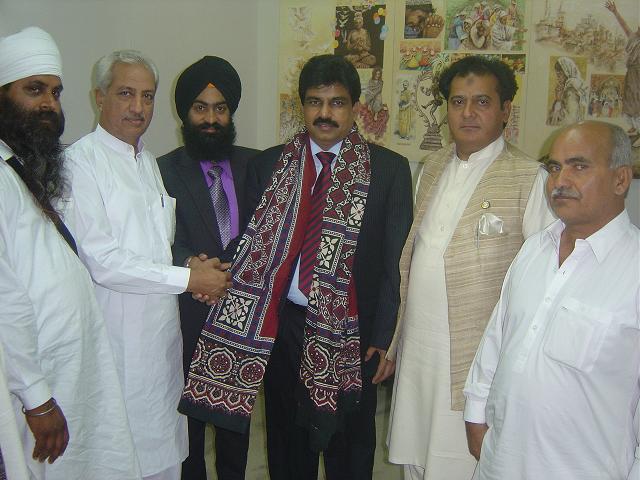
A Delegation Of Sikh Naujawan Sabha Pakistan met the Mr. Shahbaz Bhatti
Federal Minister Of Minorities Affair Government of Pakistan & Chairman Sikh Naujawan Sabha Sardar Ramesh Singh Presenting a Sindh Tradional Ajrak to Minister of Minorities Affairs Government of Pakistan Islamabad.
Press Secretary
Arjun Singh
Sikh Naujawan Sabha Pakistan
Posted on April 28, 2009 |
|
| GIANI WADHAWA SINGH GILL PASSED AWAY |
Ambedkartimes shares its deep grief over the untimely passing away of Giani Wadhawa Singh Gill , who was very closely associated with the West Sacramento Sikh temple. He was very active & dedicated to the Guru Ghar and he will be remembered forever for his services to the Sikh community.
Ambedkartimes pays floral tributes to beloved Giani Wadhawa Singh Gill Ji and sends condolences to his family and fellow missionaries on their biggest loss.
Editor:
(Ambedkartimes Group)
Posted on February 27, 2009 |
SAD NEWS OF PASSING AWAY OF GIANI WADHAWA SINGH GILL |
Our beloved Giani Wadhawa Singh Ji Gill touched our lives in many ways. We salute him for living his life as a Great Sikh and objectifying spiritual values in his conduct and everyday interaction with the community. The community has indeed lost the most revered member.
Dr. Amrik Singh & Onkar Singh Bindra, Ph. D.
SAD NEWS OF PASSING AWAY OF GIANI WADHAWA SINGH GILL |
Giani Wadhawa Singh Ji Gill, who was very closely associated with the West Sacramento Sikh temple, a past president, currently spiritual advisor to the Sikh temple passed away on Tuesday. He was a very noble soul who brought all seven Sikh temples from greater Sacramento to join hands in celebrating the 300 anniversary of the Guru Granth sahib. We are all going to miss him dearly. His funeral is likely to be on this Saturday.
Iqbal Badwalz 916-548-2248
CONDOLENCE & DEEPEST SYMPATHY |
IVACC shares the grief and loss of Giani Wadhawa Singh Ji Gill West Sacramento Sikh temple; He will be remembered for his services and devotion to Sacramento Sikh community. God bless his great soul rest in peace.
Sukh C. Singh- General Secretary
Indus Valley American Chamber of Commerce, Elk Grove (Ca.)
Funeral and Shri Sahej Path |
With a very heavy heart we share the sad news that our beloved Giani Wadhawa Singh Ji Gill passed away at home on 2/24/09 after a short illness. Giani Ji had touched many lives and hearts. His loss is beyond description for our community. The information about his Antam Saskar (Funeral Services) is as follows: Saturday 2/28/09 from 11 AM - 1 PM Funeral Services at North Sacramento Funeral Home, Funeral Home Address: 725 El Camino Ave, Sacramento, CA 95815 Phone: (916) 922-9668 Saturday 2/28/09 From 2pm – 3:30pm Arambh Shri Sahej Path -at Sikh Temple Sacramento will start after the Antam Saskar. (916) 922-9668 Saturday 2/28/09 From 2pm – 3:30pm Arambh Shri Sahej Path -at Sikh Temple Sacramento will start after the Antam Saskar.
Sikh Temple Address :
2301 Evergreen Ave , West Sacramento , CA 95691
Phone (916) 371-9787 Saturday 3/7/09 Bhog Shri Sahej Path and Kirtan Program 3 - 5 PM At West Sac. Sikh Temple. Please feel free to share this news with others. Sadh Sangat Da Das, Saturday 3/7/09 Bhog Shri Sahej Path and Kirtan Program 3 - 5 PM At West Sac. Sikh Temple. Please feel free to share this news with others. Sadh Sangat Da Das,
Mohinder S Sandhu General Secretary
Sikh Temple Sacramento, 2301 Evergreen Ave , West Sacramento , CA 95691
e-mail: sikh.temple.sacramento@gmail.com
Posted on February 27, 2009 |
REMEMBRANCE BHOG
IN THE LOVING MEMORY OF LATE TEJINDER SIBIA |
In the memory of Late Tejinder Sibia, Mrs. Manjeet Sibia, Mr. and Mrs. Karn and Kirn Jakhed have made arrange for a memorials service at:
SIKH TEMPLE SACRAMENTO, 2301 Evergreen Avenue, West Sacramento , CA. 95691,
On Saturday Feb. 28, 2009 from 6: PM to 7:30 PM, Ph. # is  916-371-9787 916-371-9787
All friends and relatives are invited to attend. His loss is for ever felt by every one. For further information please contact: Mrs. Manjeet Sibia 916 717 5441, 916 419 3511
By:Chainsukh@aol.com
Posted on February 21, 2009 (1:28am) |
Press Note
ON THE PATH OF BEGUMPURA
- Release of Sach Ki Bani-Universal Message for Peace
Edited by Swaranjeet Singh, Harvind Kaur Singh and Kulwant Singh Hundal,
Published by Institute for Conflict and Peace Studies |
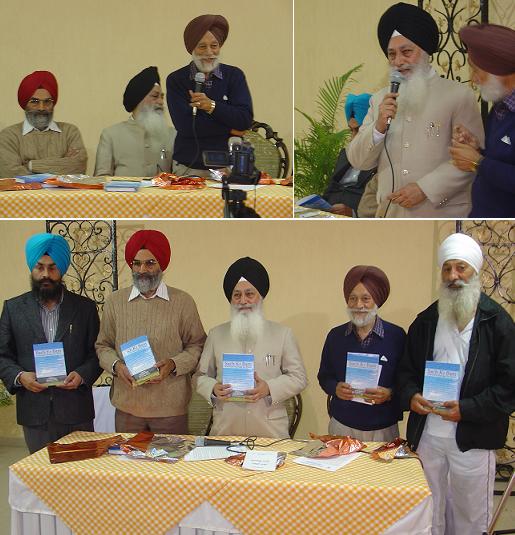
The Gurta Gaddi Tercentenary celebrations have stopped. The search for eternal peace, tranquility and soul-satisfaction continues. You are invited to participate in this ongoing journey, the path of which has been laid down by the Bani of the Gurus. To take you into the deeper realms of Gurbani, through practical experience and academic excellence, the editors of this new volume dedicated to the Tercentenary celebrations, Sach Ki Bani –Universal Message for Peace, have brought forth a unique rare fare in two languages –English and Punjabi.
Authors Swaranjeet Singh, Harvind Kaur Singh and Kulwant Singh Hundal, under the aegis of the Institute for Conflict and Peace Studies have compiled a compendium of especially written articles by scholars and Sikh practitioners far and wide, for they believe that “the current dissonance between those who claim to be experts in Sikhism and those who are immersed in the praxis must be confronted. This gulf is ever expanding; however, a true bridge between the two is necessary in order to more fully realize the essence of what Sikhism is and means to a wide spectrum of believer and non-believers.”
Like all Sikhs the editors are convinced that the truth contained in the writings as composed in Guru Granth Sahib are eternal. However, they have significantly pointed out that, “while many efforts at interpretation and understanding exist and assist in creating awareness, the true essence and meaning for each individual remains tied to their own effots at deciphering and realizing the truth within the sacred words.”
Acknowledging that there can be no studies without use and understanding of the Gurmukhi language, this is a bilingual volume combining the best of both the worlds, for as SS Ek Ong Kaur Khalsa says in her piece on Dharam Khand, the English language is perhaps inadequate to express the rich language and content of Gurbani while detailing human consciousness.
This unique volume starts with the extraordinary enunciation of the Japji by Sirdar Kapur Singh. It contains the amazingly mystical and magical journey into the cosmos through Gurbani, exploring the relationship between religious studies and natural sciences by Nikky-Guninder Kaur Singh. New York University professor IJ Singh while dwelling on anthropology and the mystique of the Sikh scripture, clearly recalls the Guru’s words “that it is not the sight and idolization of the Guru Granth that is liberating, but engagement with the word therein.” Gurtej Singh explains the pluralism of the Guru’s word, Swaranjeet Singh, the executive director of the Institute for Conflict and Peace Studies goes through the role of Sikh women in religious texts and Sikh history and seeks full implementation of equality to women in Sikh society. Manjyot Kaur revels in the ecstasy of the company of Guru Granth Sahib, Jaginder Singh Ramdev details the contribution of Bhagats, Swaraj Singh and Ranbir Singh Sandhu extol the universality of the message of the Gurus, ace chronicler Raghbir Singh Bains emphasizes the need of Gurbani for democratic functioning and universal peace, while Kulwant Singh Hundal explores the shades of Maya and Gurbachan Singh Bachan traces the physical ecology from the pre-universe era to the creation of the present universe and this article should serve as an inspiration for scientists looking at the relationship between this aspect of science and the Sikh religion.
As always, the Panjabi section is laced with inspirational articles. In their respective articles, veteran Sikh writers Jaswant Singh Neki, Kulwant Singh Hundal and Niranjan Singh Dhesi take the reader on a spiritual journey on the path to Begumpura. The articles on Raagas by Dr. Gurnam Singh, the contemporariness of Guru Granth Sahib by Devinder Singh and the importance of Guru Granth Sahib in today’s ultra-modern age by Bhupinder Singh Khehra are a ready reckoner about the basic tenets of the Sikh faith and are of immense value to the lay reader. Swaranjeet Singh, Kulwant Singh Hundal and Darshan Singh have explored the social ramifications of Gurbani in their articles.
A common thread of peace, compassion and proximity to God and godliness runs through all the articles in this path-breaking 300 page reasonably priced volume which was released today in Chandigarh by Gurtej Singh -former IAS officer and National Professor of Sikhism, Dr. Darshan Singh –former Professor and Chairman of Department of Guru Nanak Sikh Studies, Panjab University –and Rajinder Singh -the chairperson of the Shiromani Khalsa Panchayat.
Perhaps the best way to commemorate the Tercentenary celebrations is to spread the Guru’s word, their teachings, philosophy and way of life to as many people as possible so that mankind can benefit can be inspired to the creation of Halemi Raaj and to seek and establish an equalitarian order on the lines of Begampura as enshrined in Guru Granth Sahib.
Undoubtedly, readers in Panjab, the Diaspora and elsewhere would immensely benefit from this work of the Institute for Conflict and Peace Studies, whose sole and primary motive is to provide a forum of free exchange of thought processes incorporating Gurbani whose reach is universal. This book will provide a stepping stone to social scientists and activists concerned about creating a new world order and also to those who would like to embark on a spiritual journey.
Editors: Sach Ki Bani
Dr. Swaranjeet Singh is a Founder and executive Director of Institute for Conflict and Peace Studies (IFCAPS). He earned his PhD in Panjabi Language and Literature from Panjab University , Chandigarh . His work focuses on Sikh historical novels. He passed NET (National Eligibility Test) from UGC (University Grant Commission, Delhi ) in 1991 for Lectureship in Indian Colleges and Universities. Dr. Singh holds a Master’s in Panjabi and a Bachelor’s from Panjab University , Chandigarh . He also completed a Certificate Course in Persian to gain more complete research skills for his work in Sikh History. Dr. Singh has served as a lecturer in several colleges throughout Panjab. He left lecturing after more than seven years of graduate and undergraduate teaching experience in 2000. For a short while he was appointed the assistant editor of the Sikh Studies Quarterly, by Gurtej Singh, editor of the same journal in the Institute of Sikh Studies , Chandigarh . He resigned from this position in 2001 and migrates to USA , where he earned Associates in Accounting from OCC. He is the author of BUTT PARASTH NAHI AKAAL PARASTH. This text is a remarkable work that outlines Sikh strategy and important Sikh concerns regarding the onslaught of fascist organizations under the umbrella of the R.S.S. This document was originally published at the request of Joint Action Committee (Now Shiromani Khalsa Panchayat) in 2000. The original brochure was published anonymously. He has written ROSHAN ZAMEER and SACH SUNAISI books. His articles have been published in Amritsar Times, Chardi Kala, Panjab Times and The Sikh Bulletin, Spokesman, Shahadat International, Sikh Shahadat and Aaj Di Awaz. He is also the Co-Editor with Gurtej Singh SHAHEED BILAS: SANT JARNAIL SINGH. He contributed six articles on Bhagat Singh controversy which were published in SIKH CHETNA ATE BHAGAT book. He is also a Former Media Coordinator of Sikh Religious Society, Palatine .
Harvind Kaur Singh is a Director of Communications of Institute for Conflict and Peace Studies (IFCAPS). She began her television career as an undergraduate at the University of Missouri-Columbia where she completed her degree in Journalism and Philosophy. She received an Emmy Nomination for her weekly series Educate! which aired locally on WYCC-TV Chicago. She earned Master degree in Divinity from University of Chicago . She holds a Master in Liberal Arts and a Master in Divinity with a concentration in the history of religions. Kaur is a professional documentary producer. Her works have aired on PBS and her community related work was showcased at the first Spinning Wheel Film Festival in Toronto . Keep the Faith is her first Sikh focused project. She is currently working on two other community related projects including a series of programs designed to highlights the achievements of Panjabi’s across the globe. The first installment of the series titled Sikh Portraits: Glorious Past, Brilliant Future will focus on the life and achievements of US Congressman Dalip Singh Saund. Her other project which is still in production deals with the unheard voices of India ’s minority communities. The project titled, India : Democratic Miracle or Mirage? has a corresponding website www.democraticindia.org. The trailer can be viewed on-line. This visionary and proactive program was premiered and launched at the Gene Siskel Film Center in Chicago in 2003. She is currently Vice President of Singh & Associates, Inc. and actively writing in Sikh chic. Her articles have published in Amritsar Times (English and Panjabi edition), World Sikh News and Indian Reporter.
Kulwant Singh Hundal is an Executive Secretary of Institute for Conflict and Peace Studies (IFCAPS). He completed his high school education from Lyallpur Khalsa School , Sham Chaurasi. He joined Indian Navy in 1958 and during this period received Master’s in English and Political Science from Panjab University , Chandigarh . He served as Lecturer in English at Lyallpur Khalsa
College, Jallandhar from 1969 to 1979 and migrate to USA in 1979. He is a Former President and Religious Secretary of Sikh Religious Society, Palatine and Former Executive Member’s of AGPC and WSC. |
Posted on February 8, 2009 |
GURU NANAK DEV JI’S GURPURB
CELEBRATED IN JALANDHAR |
By: C L Chumber
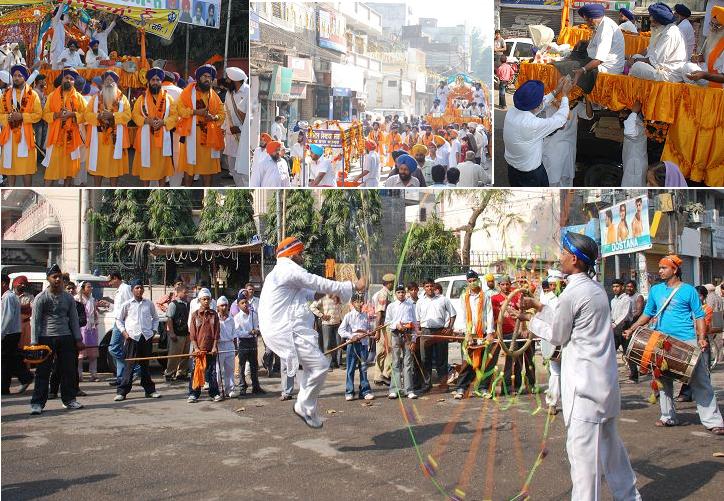
Jalandhar: A Nagar Kirtan in honor of Sikhs’ first Guru, Guru Nanak Dev ji was organized on November 10, 2008 by city Gurdwaras, Sikh organizations and educational societies. The procession was led by Guru Granth Sahib on well decorated float escorted by Panj Piaras. On the route of the procession, the sidewalks were crowded with people from all walks of life. They savored food prepared by Sikhs, business houses and social organization. The spirit of serving others pervaded highlighting Guru’s message of harmony. Members of all political parties took part in the Nagar Kirtan. A newly declared nominee of Jalandhar Parliamentary seat, Hans Raj Hans was seen interacting with people of his constituency. Gatka parties exhibited their skills to the awe of curious onlookers. City schools and colleges participated in a big way along with their teachers.
Posted on November 22, 2008 |
Gurus
words Reign Supreme
at 29 th Sikh Parade in Yuba City
Dr. Amrik Singh writes from Sacramento |
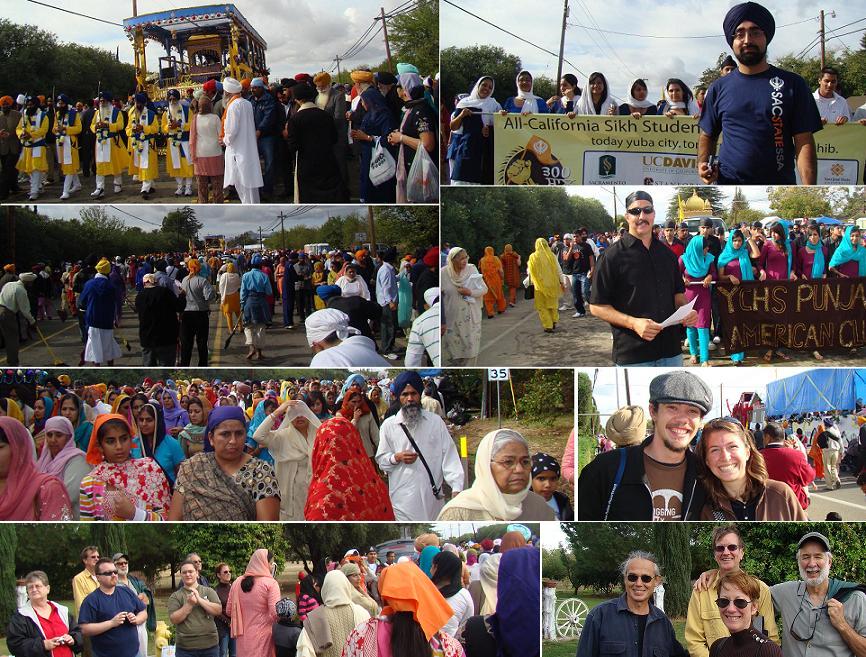
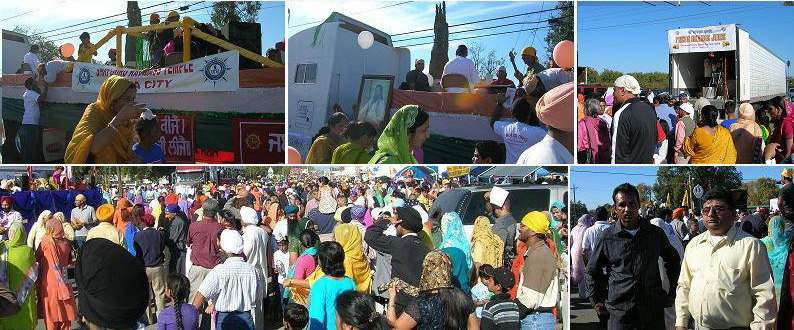
1 Leading Float escorted by Five Beloveds of the Guru, 2 All California Universities and Colleges students feel proud to be a part of the Parade, 3 Devotees sweeping the path for the Holy March, 4 Punjabi Learners of Yuba City High School with Supervisor of Sutter County Jim Whitekar, 5 Following the leading float, Sikh men and women walk listening to Shabad, 6 Steve and Rachel are students of Punjabi class at SCC, UC Davis, 7 Curious to know about the message of the Parade, Yuba City Residents look at the main float, 8 Sacramento Residents Robert, Garry, Pete and Pam attracted to the Parade
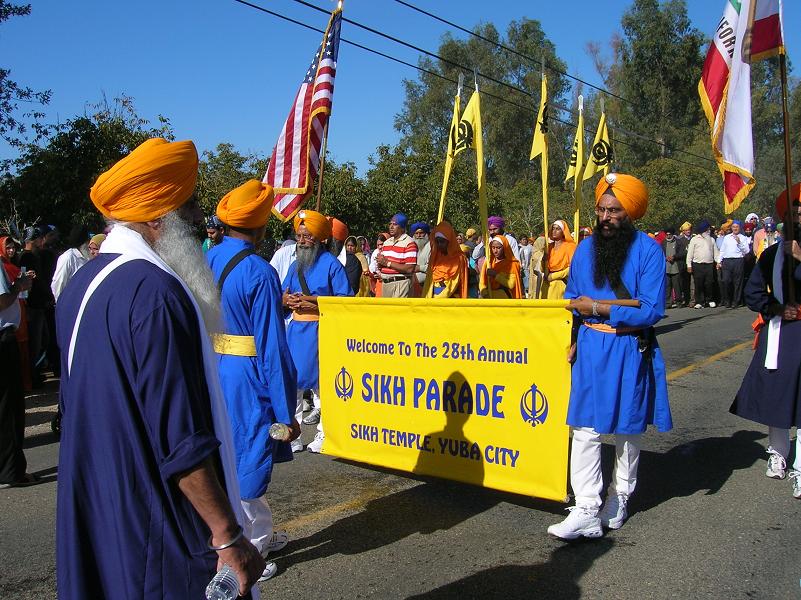
29th Sikh Parade in Yuba City on November 2, 2008 was a special occasion this year. Global Celebrations linked with 300 years of enthroning Guru Granth Sahib as the spiritual Head of Sikhs has attracted attention of the world community. Guru Granth Sahib’s universal message of peace is looked upon as one of the possibilities of enshrining world peace.
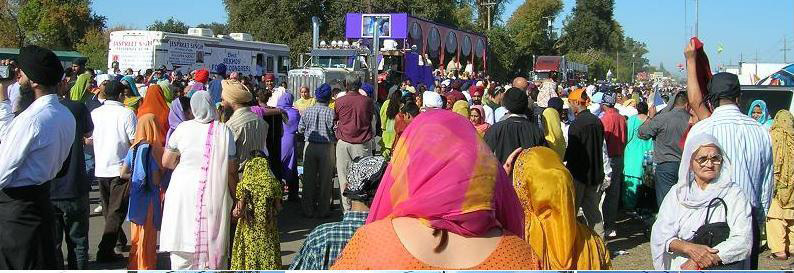
An estimated 65- 70 thousand people joined the parade. Sikhs came from as far as Washington, DC, Los Angeles, Espanola, New Mexico, Vancouver, Canada to honor their Guru’s message to believe in One God, Work Hard, Share with Others, and universal brother and sisterhood of mankind. Besides Sikhs, people from almost all faiths joined in the parade and expressed their thankfulness for a unique experience.
Sikh temples from all over USA, Sikh organizations, Sikh Student Associations, Cultural Clubs and Business Organization had their floats decked with multi-colored backgrounds with motifs of Guru’s message, Religious music played adding to the dreamlike atmosphere of the parade. T.V. crews, journalists of ethnic and American media and artist were seen busy in covering 29 th Sikh Parade. Over the years, the Sikh Parade has blended with diverse cultures of Sutter County. Despite the traffic congestion on the streets, Americans living in the surrounding areas consider it as a most welcoming event. It provides an opportunity to them and their families not only to savor a variety of ethnic foods but also adds to the color of their life.
The excitement of the younger generations in preparing, decorating and equipping their floats gives them positive energy to stay away from drugs, crimes and gang involvement. They consider themselves a part of the community that advocates recognizing other faiths, groups and belief systems.
The Sikh Parade also increases interaction of the community with elected officials, lawmakers and law enforcement. It is a great challenge for the Sutter County to make arrangements for the parade. Lt. Governor John Garamendi joined the congregation on Saturday, November 1, 2008 and watched a movie about the universal message of Guru Granth Sahib. Three more movies were screened to make connection with the Sikh history. One such movie focused on the tragic life of Maharaja Dalip Singh who suffered unbearable miseries at the hands of the British. Sherriff department had made elaborate arrangements to maintain order for the free flow of traffic on the streets.
The writer talked with a number of people to know about their experiences who came for the parade for the first time. Robert, Garry, Pete and Pam came all the way from Sacramento. Though they did not know anything about the actual purpose of the Sikh Parade, they however figured out it was for peace. On being informed about Guru Granth Sahib’s uniqueness, one of them suggested some written information would have been very helpful for the first timers like him. Students of Punjabi course at Sacramento State University and Sacramento City College at Davis while enjoying the Parade were able to read many signs in Gurmukhi and were so happy to experience what they were learning in the classroom. Katie though lives in Yuba city for the last four years, but came for the first time on the suggestion of a certain friend. She said it was so ennobling for her and her children that she would not miss any parade in the future.
A special studio on behalf of Comcast Cable News Network was set up at the premises of Professor Hari Singh Everest’s on Tierra Buena Rd. Dr. Jasbir Singh Kang of Sikh American Heritage held special interviews for Central Valley Comcast. Dr. Onkar Singh Bindra, a former Professor and Alumni of UC Berkeley distributed information about the approval a new course “Sikh American and Globalization” at California State University Sacramento. TV channel 8 will telecast the coverage of the Parade on November 23, 2008 at 4 PM and November 29 at 3 PM. It is also available on Online www.mykbtv.com . Newly founded JUS Punjabi TV on Dish Network Channel 809 covered live all proceedings of the 29 th Sikh Parade.
Posted on November 04, 2008 |
Sikh Style Capitol Rally for World Peace |
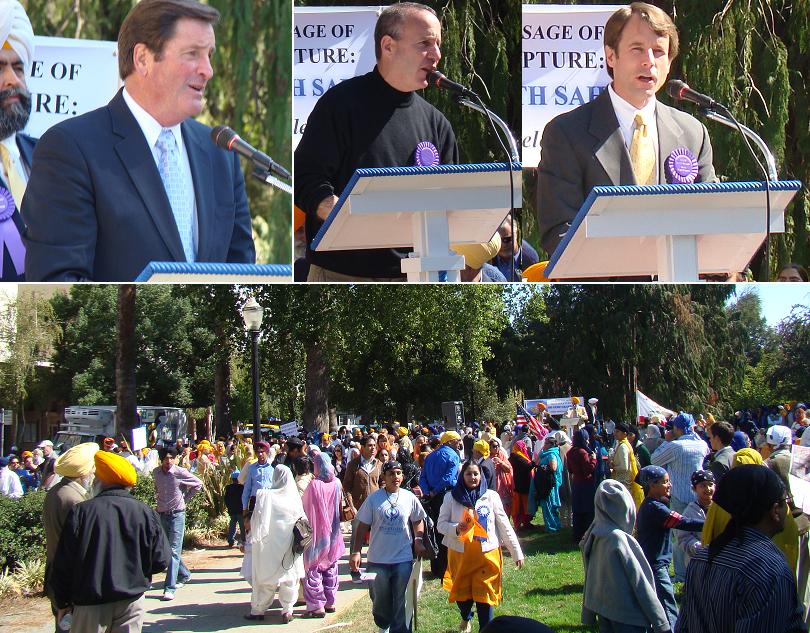
Photos:
Left to right: Lt. Governor of California State John
Garamendi, Senator Darrell Steinberg, President California
State Senate,
David Jones Assemblyman California State Legislature and
Sangat for the March for World Peace on 11 Oct. 2008 at
Capitol Sacramento
Report & photos by Dr. Amrik Singh Sacramento
State Capitol of California recorded an unparalleled event on Saturday, October 11, 2008 when members of interfaith groups joined Sacramento Valley Sikhs in the March for World Peace and Capitol Rally. The occasion was to commemorate 300 years of spiritual leadership of Guru Granth Sahib, acknowledged as the Eleventh and the last Guru of the Sikhs. Ten Sikh Gurus in human form between 1469 A.D -1708 A.D. guided Sikhs to recognize the unity of Mankind on our planet and the Fatherhood of God in the entire universe. Guru Granth Sahib embodies revelations of Sikh Gurus, saints, seers and visionaries who stress enshrining of God’s Name in the center of consciousness as the sure way to peace. In 1708, the tenth Sikh Master, Guru Gobind Singh ordained Sikhs to seek guidance only of the written words in the Holy Scriptures, thus ending the possibility of any human to gain the status of Sikh Guru in future.
In the first leg of the Rally, members of the Interfaith groups and Sikhs gathered at the Southside Park where Sikh leaders drew attention to the significance of Tercentenary Celebration worldwide. A specially customized vehicle carried Guru Granth Sahib as the leading float of the rally. Sikhs and other participants followed in a March to the Capitol in Downtown Sacramento. An array of California State leaders, Assemblymen, Senators, Mayor of Sacramento and Interfaith leaders gathered on the lush green lawns of the Capitol to deliver their Special Message to Sikhs for their efforts to create mutual understanding among people of diverse ethnicities and religious backgrounds.
At the Capitol, the keynote speaker was Lieutenant Governor of California, John Garamendi who praised Sikhs for their hard work, positive attitude, and a spirit of sharing with other communities. Tercentenary celebrations of Guru Granth Sahib indeed are efforts to bring peace by invoking Guru’s blessings. President of the State Senate, Senator Darrel Steinberg declared that Sikhs were always welcome to the State Capitol as special invitees. Mayor of Sacramento Ms. Heather Fargo mentioned how on September 13, 2001 only two days after 9/11 Sikhs came out in a big way to extend moral and financial support to victims of twin towers. NBA star and Mayoral candidate Kevin Johnson waited long for his turn to deliver his message. Assemblyman of 9 th District David Jones presented a special Peace Resolution on behalf of the California State Assembly thus making Tercentenary celebration historical for California. Mike Moran of Spiritual Life Center, Interfaith Service Bureau said Guru Granth Sahib Message was evident in the enthusiasm of Sikhs to reach others. Ex-President David Thompson said how love and peace in action was needed to remove doubts and ignorance. Mr. Jay Alan, Deputy Director of Communication, Governor’s Office of Homeland Security, Supervisor Mariko Yamada, Supervisor Roger Dickinson, Councilmember Mark Johannessen, the City of West Sacramento, Ms. Durriya Syed, President of Interfaith Bureau Service, Don Saylor, Mayor Pro tem City of Davis were others who addressed the audience.
Earlier, Bhai Ranjit Singh of West Sacramento Gurdwara started the Capitol Rally with Sikh Prayer. Giani Wadhawa Singh Gill Religious Advisor emphasized to recognize all pervasive Fatherhood of God. S. Mohinder Singh Sandhu, General Secretary of West Sacramento Gurdwara, and Dr. Gurinder Singh Kanwar conducted the stage events very successfully. Dr. Gurtej Singh Cheema, Dr. Narinder Singh Parhar President of Bradshaw Gurdwara, JP Singh of Sikh Temple, El Sobrante, Mr. SS Raikhy a CEO, Mr. Jaswinder Jandy of Gurdwara Fremont, Balbir Singh Dhillon President of Gurdwara West Sacramento, and Darshan Singh Mundy, Public Relation Officer expressed their ideas on the significance of the Tercentenary Celebrations all over the world. A message from Sri Akal Takhat Sahib was also read. At the Southside Park Mr. Kawal Bolina read message on behalf of the entire Nor. Cal. Sadh Sangat. The following Sikh leaders also addressed the gathering: S. Paramjit Singh, Gen. Sec. Shri Sach Khand Sahib, Sikh Temple Roseville S. Maheshinder Singh, Gen. Sec., Sikh Temple Roseville, Melody lane Amar Baidvan of Shri Guru Ravidas Temple Rio Linda, Taran Hundal & Amandeep Dhariwal - Sunday School, West Sacramento Sikh temple, Bhai Bikram Singh Ji, Guru Nanak Sat Sangat of California, Sikh Temple Elsie Road. An airplane with the message “Guru Granth Sahib 300 Years Peace Recipe” hovered in the Sky throughout the ceremonies. An estimated eight thousands people took part in the celebrations. Free breakfast, lunch, snacks and beverages were served in plenty.
Posted on October 18, 2008 |
|
|
CALIFORNIA DEPARTMENT OF EDUCATION
APPROVES SIKH COLORING BOOK |
By Onkar Singh Bindra, Ph. D. (U.C. Berkeley)*
In America , there is widespread ignorance about the Sikhs. Because of their turban and beard, Sikh men are often called Osama bin Laden. Sikh children have to face bullying and harassment. Recently, the Patka of a Sikh boy was set on fire in New York , while another Sikh boy was beaten badly. We need education, education and education. For educating the masses about Sikh identity, it is very important to include information about Sikhs in the textbooks and Supplemental Instructional Materials (SIM).
Last June, this reporter pointed out to the California Department of Education (CDE) the need for inclusion of “The Boy with Long Hair” in the SIM, and advised the publisher, to submit it for approval. It is a pleasure to report that the said coloring story book has now been approved by the CDE for grades K-3.
The Boy with Long Hair is a true story of a California-born Sikh boy. He was quite happy in San Jose . His family moved to a small town where they had not seen a boy with long hair. Here, no one wanted to play with him, or talk to him. His isolation saddened him and ignorance of kids around him angered him. This book tells the story of courage and triumph of this young boy, how he dealt with the situation and finally became happy as the boy with long hair. His unique identity was no longer a problem. Everyone in his school knew him as an intelligent fun-loving boy.
In the words of the author (Pushpinder Kaur), it is a story for all those children who have felt left out and lonely because their heritage has given them customs that seem strange to some people. It is the story of a boy who knows that although people may look or behave differently, there is much that they share. She states, “This coloring book teaches children to be proactive, finding solutions to problems. Children and teachers alike realize that we have many similarities despite our differences, as the boy with long hair points them out. This book sends a powerful message about respect for diversity of our nation ( America ).”
It may be noted that earlier, this reporter got the following two items approved for use in California’s public schools: (1) “Meet the Sikhs”, a short DVD produced by PBS/KVIE, Sacramento (www.kvie.org ), now viewable on “You Tube”, and (2) “The Sikh Next Door” of Lohgarh Sikh Educational Foundation (www.sikhnextdoor.org ). With the approval of “The Boy with Long Hair” of the Sikh Foundation (www.sikhfoundation.org ), we will now have three items on the SIM.
It is extremely important that Sikh parents request the teachers of their school children to make use of these Supplemental Instructional Materials. Gifting one or all of these to the teachers and the Principal concerned will definitely encourage them to use these CDE-approved instructional materials, for education of the staff and the students. Readers are requested to convey this message to Sikhs throughout California . (Prof. Onkar S. Bindra, Sacramento : osbindra@yahoo.com)
Posted on August 31, 2008
====================================================================================================
*Onkar
Singh Bindra, Ph.D. (U.C. Berkeley): Formerly
Head of Entomology Dept., Punjab Agriculture Univ., Ludhiana,
India; Retd Entomologist, Food & Agric. Organization of United
Nations; Ex-Board Member, Renaissance Society, Calif. State Univ.,
Sacramento; Trustee Sikh Temple, Sacramento. Ph.(916) 858-2650 |
California Schools: History Framework
The History-Social Science Framework for California Public Schools, available at http://www.cde.ca.gov/re/pn/fd/documents/hist-social-sci-frame.pdf , governs the topics that publishers must include in the history-social science textbooks. The current edition of the Framework does not have even a word about the Sikh identity, culture, history, or religion. It is now under revision. A Framework Focus Group met on May 7 at Sacramento, where Prof. Onkar Singh Bindra and Dr Gurtej Singh Cheema made comments. The Focus Group will meet on May 30 in the Santa Clara County, on June 5 in Los Angeles County and on June 6 in San Diego County, in County Education Offices. Sikh activists have been informed and requested to make Public Comments at those meetings, and to submit what additions/changes are needed and where.
Prof. Bindra also made a Public Comment at the May15 meeting of California’s Curriculum Commission. Inviting attention to the loss of lives of five Sikhs in hate crimes, starting with that of Balbir Singh Sodhi on Sept. 15, 2001 in Mesa (AZ), and to last week’s incident of a student setting on fire the Patka of a Sikh student in a New Jersey school, he said, “What we need is education, education and education.” He requested for inclusion of images, script and activities relating to Sikh appearance, culture, history and religion in the Framework. Finally, he presented to the Chair an educational DVD, “Sikhs in America”. Produced by the KVIE Sacramento, Public Television of Northern California, it has won an Emmy award in the category of Best Historic/Cultural Program. Readers may contact www.kvie.org for a copy of the DVD and their local TV station regarding its screening.
By: Onkar Singh Bindra, Ph.D. (U.C. Berkeley) Formerly Head of Entomology Dept, Punjab Agric. Univ., Ludhiana, India;
Retd Entomologist, Food & Agriculture Organization of United Nations; Ex-Board Member, Renaissance Society, Calif. State Univ., Sacramento; Trustee Sikh Temple, Sacramento. Ph. (916) 858-2650
(Posted on www.ambedkartimes.com May 19, 2008 ) |
 |
Sikhs, Swamis, Students and Spies
The India lobby in the United States, 1900-1946.
By Harold A. Gould
460 pp. Sage Publications. |
Book
Review by
Dr. Amrik Singh
(Sacramento)
|
Harold A Gould’s book, Sikhs, Swamis, Students, And Spies: The India Lobby in the United States 1900-1946 is a landmark study of pioneers’ quest for freedom, love and justice both in lands of their birth and the lands they bowed to make green. Their contribution, according to Gould, will remain exceptional in the annals of history. Their dream of undivided India, though, could not become a reality due to the inept handling, yet their extraordinary role in becoming catalytic agent of change would alter our perception. Gould focuses on 1900-1946 period to dig out the truth behind the British’s eviction from India. His narrative flows uninterrupted through out 460 pages, mainly because he avoids hot spots of controversies for a more authentic account. Unlike most post-independence Indian historians, Gould constructs a comprehensive image of Ghadrites in championing the cause of freedom. Obstacles in the way to attain citizenship roused their ire creating a response that ironically advanced the cause of civil rights on both sides of the globe.
The author clearly explains how a small community of not more than 5000-6000 in 1910-20, had originally conceived a dream of claiming their country from clutches of the colonialists. In their monumental efforts, they struggled on behalf of then 260 million Indians who were being magnetized and mesmerized with glamour and glitz of colonial lifestyles. Pioneers’ lobbying efforts promoted the cause of freedom in American media, academia, and the society. The armed incursion of revolutionaries, though, suffered many jolts as British intelligence had made deep inroads into the very heart of Ghadr, however, it fueled the imagination of Indians to explore possibilities of free India. The title of the book, in fact, is a quip of Lala Hardyal who used it to categorize Indians in America as Sikhs, Swamis, Students and spies; it is so apt and apposite to the subject matter that it holds readers’ interest until the end.
The main plot revolves round Ambassador William Phillips’s assignment to India and his highly confidential report on British Raj’s hollowness and callousness in suppressing the voice of freedom and jeopardizing ongoing war efforts. Through his private report, Phillips urged the President Franklin D. Roosevelt to take action against the British in view of the common agenda adopted by allies in World War II. Since the lobbyists had sympathizers in the US state department, the confidential letter to the President found its way in the most popular column of the Washington Post. Drew Pearson’s “The Washington Merry-Go-Round” created a rift right in the middle of World War II. Who had leaked the information to the press? Gould reveals the name for the first time in the book under review.
The book has been dedicated to Professor I. Crane (1922-97) whose name is linked for the first time to the greatest mystery in the state department leakage case of 1943 to one of the columnists of the Washington Post. This disclosure hit hard at the British’s orchestrated campaign of constructing myths in America about benevolence of the British Raj. J.J. Singh, who was known as ‘one-man lobby’ and a genius of public relations among his American sympathizers, had worked hard to advertise Indian freedom movement. The author comments that firebrand leader like Lala Har Dyal though provided organizational support initially, yet could not manage to run the affairs for long due to British operatives’ threat. However the recruits mostly Sikhs, some Hindus and Muslims as well stood trial and some achieved martyrdom as wages for their allegiance. Professor Crane says about Sikhs: “They were all patriots and wanted India to be free, but they also wanted American citizenship.”
The intertwined motif of ending discrimination on the basis of race made pioneers willing partners in fight to the finish. The struggle for freedom starting in 1900 in North America continued with the same fervor though different routes had to be followed for achieving results. After the First World War, Punjabi pioneers’ influence looked unstoppable as they had 122,000 acreage in their possessions. Immigration & Naturalization Services’ decision to challenge the verdict of a district court in the US Supreme Court won support of Anglo Americans as a deterrent measure. Their main angst was pioneers’ unquenchable thirst for agricultural lands. The British Raj succeeded in convincing US government to try in court of law all revolutionaries for conspiring an armed incursion with money pumped by imperial Germany. The trials, according to Gould, were a media circus. “It lasted 155 days; cost the US government $450, 000 and the British government 2.5 million. The amount the British spent is obviously a measure of how threatening they believed Ghadr, in concert with the German enemy, had become.” In trials, the British had a motive for using American media for stereotyping ‘Hindoos’ as people of violent and criminal bent of mind. The phenomenal amount of dollar spending to suppress a small group of radicals through infiltration on the one hand and to egg on non-violent movement involving a larger population was the only course left to sidetrack barrels of guns from faces of Raj’s custodians.
In the 47 years of journey, Ghadr pioneers and their friends continued financial, moral and nationalistic support to the lobbyists. The median income of Indian Americans in 2005 is over $60.000 per annum, according to Gould, higher than any other minority group. Sufferings and energies of Sohan Singh Bhakna, Har Dayal, Taraknath Das, Syud Hossain, Anup Singh, Sridharani, JJ Singh, the Sikh leaders on the Pacific Coast, and so many others like Professor Robert Crane made it possible. The tenacity of their purpose and steady financial support won a badge of American citizenship when President Harry S. Truman signed ‘Celler-Luce Bill’ on July 2, 1946. The relief applied to all people of the Indian subcontinent. Gould emphasizes that isolating Ghadr from the latter-day campaigns will result in belittling its historical role. Gould opines, “The intellectuals were especially crucial in developing the various organizations that promoted political awareness and provided framework for collective action. Ghadr was a classic manifestation of this fateful conjecture, as were the organizations that followed, such as the Friends for Freedom of India, the India League of America, the Indian Chamber of Commerce of America, and the National Committee for Indian Freedom, the India Welfare League, etc.”
The armed invasion for liberation fantasized by Ghadrites may look a mere figment of imagination today, but for British intelligence it was a big plot to single out and dispatch white people from India. The interception of a ship, Henry S loaded with 5000 pistols at the sea was though a major success of the British intelligence, yet it spread panic among whites. The great enthusiasm of revolutionaries had stunned the ruling minority of India. The intelligence planned to create a counter political movement that might be not only culturally savvy and socially well-liked, but also damaging to the radicals. The double edged sword fashioned by master minds of the British intelligence both worked to decimate the influence of radicals in India as well as in the US. The main goal of underground operatives was to send early signals of an impending uprising.
Lobbyists’ efforts definitely increased American intervention in forcing the British to leave India. The President Harry S. Truman’s declaration of citizenship to Indians in 1946, in fact, was the precursor to India’s liberation in 1947. It is a different matter though colonialism continued in post-independent era in different indigenous forms. This could have been the only reason that Indian successive governments became apathetic to the demand of erecting a commemorative structure for Ghadr martyrs.
Sage Publication has done a good job except for errors in Professor l. Crane’s year of birth. Readers won’t know which one is right— 1920, 1922 and 1927.
Posted on www.ambedkartimes.com (December 20, 2007) |

.JPG)


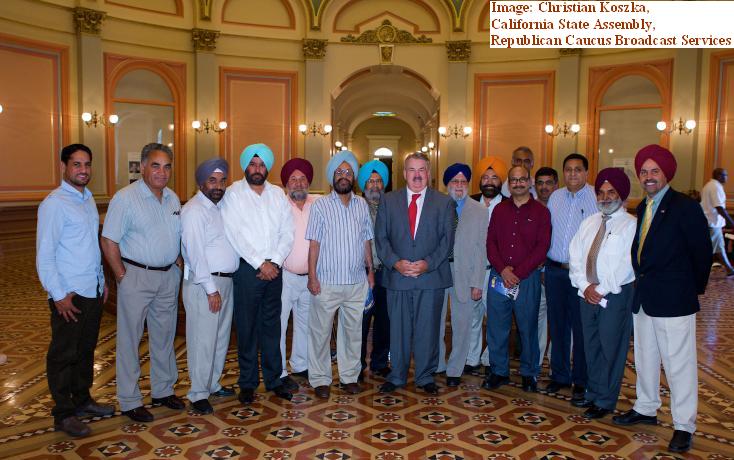
 Late
Surat Singh Dhillon
Late
Surat Singh Dhillon 
%20Singh.JPG)